
Garage door repair
Garage door cable repair for a door hung up crooked.
When a lift cable slips off its drum or snaps, one side of the door stops and the other keeps going, and the door wedges at an angle in the track. We take the weight off, re-seat or replace the cables, and set it level again.
Quickest is a call: (615) 810-6415
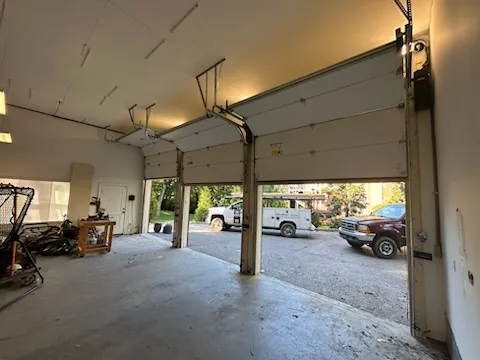
What does a thrown cable look like?
Lopsided. One bottom corner of the door sits higher than the other, the rollers on the low side may have popped out of the track, and a cable is hanging loose or wrapped in a tangle around the drum at the top corner.
Those cables are the steel ropes that run from the bottom brackets up to the drums on the spring bar. They do the actual lifting, using the tension stored in the springs. When one goes slack, that side of the door has nothing holding it.
Why do cables come off the drums?
There are a few usual suspects. A spring breaks and the cable loses its tension all at once. The door comes down on something, a trash can or a bumper, and the cable on that side goes slack and jumps the groove. Or the cable has just worn out, fraying where it hooks to the bottom bracket, the corner that sits in the wet at the edge of the driveway.
Cables and springs work as one system, so when either one fails, the other gets a hard look before we leave.
How long does a garage door cable last?
About 10,000 cycles, which is the number Clay gives customers, and a cycle is one trip up and back down. Jeanie Frautschy heard it from him on a tune-up, along with the part we’d want every customer to hear:
Clay kept me up to date on arrival time. Lubricated the necessary parts of our garage doors and informed that i need to be aware that cables have a 10,000 cycle life. So he didn’t want us to replace now, but let me know what to listen for.
Jeanie Frautschy · Google
That’s how we handle a cable that’s aging but sound. Nobody needs new cables a year early. What you do need is to know the signs: fraying near the bottom corners, a cable that looks loose when the door is shut, or a new click or slap up top as the door opens.
Leave a crooked door alone
A door hung up at an angle is still connected to springs under tension, and it can drop or slam once it comes free. Leave it where it is, unplug the opener, and keep kids and pets out from under it. That goes for a LiftMaster, a Genie or any other brand: don’t pull the red release cord on a door that’s hanging crooked, because it lets the door fall on whichever side has lost its cable.
Running the opener against a jammed door is how a cable job turns into a bent track and a bent panel as well. If the car is stuck inside, tell us that when you call.
Answers
Garage door cable repair: questions people ask
How much does garage door cable repair cost?
Less when the cable only needs to go back on its drum, more when it has frayed or snapped and both are replaced as a pair. It climbs if a spring broke too, or the bottom section and track bent when the door hung up. Clay or Chad will price it once they hear what the door is doing.
What should I do when a garage door cable breaks?
Stop using the door. Unplug the opener so nobody hits the button, keep people and pets clear, and don’t try to rewind the cable or pull the door down by hand. The door is still tied to springs under tension, and it can shift or fall once it moves.
Can you replace garage door cables yourself?
Not safely, in most cases. Replacing a lift cable means letting the tension off the springs first and rewinding them once the new cable is on the drum, which is the same risky work as a spring change. Even a cable that only slipped off a drum still has the door’s weight behind it.
Should garage door cables be replaced in pairs?
Yes. Both cables have lifted the same door the same number of times, so when one frays, the other is close behind. Replacing them together keeps the lift even on both sides, and that keeps the door running level in its tracks instead of wearing one side faster.
Why is my garage door crooked when it opens or closes?
Usually a cable has slipped on its drum, stretched unevenly or broken on the low side. A broken extension spring or a roller out of its track can do it too. Don’t keep cycling the door; every run pulls it further out of line and can bend the track or a section.